Wednesday, August 19, 2015

The 1990s Baseball Cards Face-Off - Which Set is the Best, continued

If you haven't read yesterday's post, I suggest you read it first so you'll understand what I'm doing here. I'll wait.

We left off yesterday here:

Today's face off is between 1999 Topps and 1993 Flair


1999 Topps, unlike almost all other Topps base sets, features a gold border. The front a backs are glossy and the fronts feature gold foil. The backs, like all Topps base sets, has full career stats and a good size color photo. Pretty much all the cards feature action shots. There are a number of sub-sets which I am not considering.


1993 Flair was a high-quality premium product, in it's inaugural year. It featured full-bleed printing, front and back. It is, to my knowledge, the first card to feature gold foil on the front and back of the card. The front has two photos, the main photo and a 'ghost' image in the background. The cards have a heavy, very smooth gloss finish, front and back and features heavy card stock.

Results: 1993 Flair. The 1999 Topps card is nice but it's just a routine baseball card. The 1993 Flair was something new when it was issued and it's design still looks fresh today.

1993 Flair is the second set to reach the Red Level.


Tuesday, August 18, 2015

The 1990s Baseball Cards Face-Off - Which Set is the Best

I know that a lot of you baseball card bloggers think the 1990s was a great wasteland of junk wax but I feel differently. I think the 1990s were the golden age of baseball cards. There was so much variety, so many manufacturers, something new every day.  Competition was fierce which led to innovation, and, I'll admit, excess. There was a lot of junky product but some of the best ever baseball cards were produced then. I'm going to attempt to determine the best baseball card set from the 1990s (the period 1990-1999).

I started with a list of 256 sets produced during the decade. I wanted to include only the mainstream sets, eliminating parallels and update sets. I did not include insert sets, short boxed sets, cards that focused on something other than that's year's players (so no 1953 Topps Archives) or cards that came with food products. I also wanted to only include sets which appeared in more than one year (preferably every year) but had to include those short run sets in order to bring the total to 256. I'm going to have a tournament, with brackets like the NBA playoffs. I had to have 256 sets to make it work out properly. There will be 4 divisions of 64 sets each, going head-to-head until there is only one set left standing. The Divisions will be: the Babe Ruth Division; the Ted Williams Division' the Mike Schmidt Division; and the Nolan Ryan Division. I seeded the sets randomly into each division. I was going to devise some criteria for judging each card and a point system but I'd never stop arguing with myself over how this should look. So it's all going to be based on my own opinion. Feel free to chime in with your opinions.

I'll report the results by a quartile of each Division. The bracket for a quartile will look like this.


The yellow level will be the quarter finals of the whole division. Here's the 1st Quartile of the Babe Ruth Division.

I own at least one card from each of the 256 sets so all the cards I'll be showing are from my collection. Let's get going with the first two match-ups.

The first is 1995 Bowman's Best vs. 1998 E-X 2001.


1995 Bowman's Best came in 2 flavors: Blue was for rookie cards and Red for veteran cards. The fronts were bright foil and glossy and the backs were glossy.


1998 E-X 2001 cards were printed on clear acetate. The printing on the front was in gold foil. The part with the front printing was clear so the front printing appeared backward on the back.

Results: Right out of the box we get a difficult choice as I really like both of these sets. I'm going with E-X 2001. There are only a handful of sets where all the cards are printed on plastic. In my opinion, that's a edge, just the sheer novelty of it. The choice of card stock is just as much a part of the design as the graphics and the typography. But that's not the only reason I'm choosing it. I think the cards graphics are better. The Bowman's Best cards all start to look alike after awhile while the player graphic in the E-X just pops out and keeps the visual impact from card to card.

1998 E-X 2001 moves on to the Red Round. 


This has turned into a long post so we'll pick this up tomorrow.

Friday, August 14, 2015

Walking Trivia Question

Yesterday I posted about a recent repack. I'm already working on another. One thing I like to do with baseball cards, especially players I don't know, is to look them up on baseball-reference.com and Wikipedia to learn something about the player. Once in awhile I can get a good blog post from the information.

Here is a guy who is the answer to 5 baseball trivia questions.

Who replaced Joe Torre at 3rd base for the Cardinals?

Who appeared in his only All-Star Game, in 1980, as a replacement for an injured Mike Schmidt?

Who set a National League record in 1980 by committing only 8 errors (in 150 games played)?

Who hit a 2-run homer tying a Mets-Cardinals game in the ninth, a game then went on to 25 innings before being won by the Cardinals?

Who holds the record for most career plate appearances (5079) among non-catchers who finished their careers with fewer walks than times he grounded into a double play? This last one is kind of esoteric. I'm not even sure what it signifies.

I got all of this from his Wikipedia entry and make no claims to it's validity. 

It was Ken Reitz!

1982 Fleer #602

Thursday, August 13, 2015

Repack finds

I like to buy repacks early in the year and then save them until later in the year when new cards get hard to find. I bought this one back in April. This was one of those 100-card Fairfield repacks that come in the plastic clam shells you need a laser cutter to get into.  Here I'm opening it up.

You have to be careful using these things as you can accidentally set the cards on fire. Or worst, cut a hole clear through to the basement.

Of the 100 cards in the pack, I needed 46 of them. Which I consider a good ratio. By the way, when I say I got a card I need, it's not necessarily a card I was looking for. That's how I got to 95,000+ cards, by keeping every card I buy, unless it's a duplicate.

Here are some of the better cards in year order.

1976 Topps #23 Brian Downing
 I don't have a lot of cards from the 1970s that aren't Phillies cards so I'm always happy to see some. These repacks always seem to have 4-5 of them. In the '70s I was more of a Phillies fan and not so knowledgeable about the rest of baseball, especially the American League. These red White Sox unis just blow me away every time I see one.

1976 Topps #437 Terry Forster
 Another of those red White Sox unis. I remember Forster mainly with the Dodgers and Braves in the 1980s.

1976 Topps #125 Don Baylor
I'm more familiar with Don Baylor as a manager rather than a player.

1976 Topps #256 Rowland Office
This is an 11-year player that I never heard of. Can you Braves fans out there give an opinion on whether or not this card is air brushed? I would vote yes.

1988 Fleer Glossy #184 Andres Galarraga
 I probably didn't buy any 1988 Fleer when it was new. In those days I was a Topps guy. But I kind of like this design and the Glossy version is very nice. There were two of the 1988 Fleer Glossy in the pack. The other was Sam Horn.

1988 Pacific Eight Men Out
 "Eight Men Out" was a 1988 movie staring, among others, John Cusack, Charlie Sheen, and Christopher Lloyd about the 1919 "Black Sox" scandal. Pacific put out this 110-card set featuring scenes from the film. I've pulled 10 of these now from repacks. If you're interested enough, and I'm not, you can get the 110-card set on eBay for around 10 bucks.

1988 Bazooka #13 Tony Gwynn
This is a nice little 22-card set that I now have 17 of.

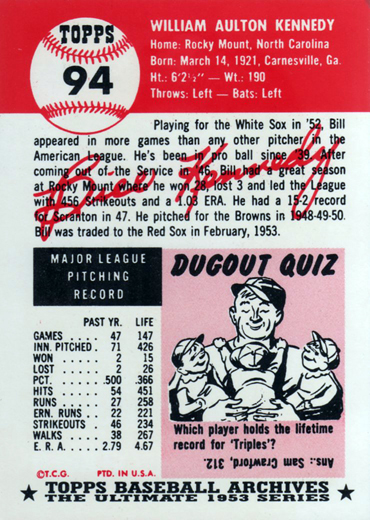
1991 Topps 1953 Archives #94 William Kennedy

This 1991 set was, I think, one of Topps earliest attempts to utilize it's past to sell new sets. It is a beautifully produced 330-card set. I own all the Phillies from the set but just a handful of other players. The cards have nice color and a nice glossy finish.

1991 Upper Deck #668 John Wetteland
Wetteland found something to laugh about in 1991, even though it wasn't his best season. He was 1-0 in 9 IP with the Dodgers. He was traded to the Reds for Eric Davis and later to the Expos for Dave Martinez but didn't pitch for either team. This is an example of a card I actually want as I'm trying to complete this set.

2005 Leaf Limited #71 Milton Bradley
Another card I actually wanted as I didn't have any cards from this set. This goes right into the reference books.

2006 Topps National Baseball Card Day #7 Alex Rodriguez
Whatever happened to National Baseball Card Day?


Wednesday, August 12, 2015

Bonus Babies

From 1947 to 1958, Major League Baseball operated under the "Bonus Rule". Under the rule, if a team signed a new player to a contract worth more than $4,000, the team had to keep the player on the 25 man roster for 2 years and could not assign him to a farm club. If a team violated the rule, the player was exposed to the waiver wire. After 2 years, the team could assign the player to the minors.  The rule was re-instituted in 1962, when the leagues expanded by 4 teams. It was finally repealed in 1965 when baseball instituted the draft system.

It was called the "bonus rule" because it prevented wealth teams from giving large signing bonuses to young players and then stashing them in the minors, which was the practice prior to 1947.

Players between 1947 and 1965 that went directly into the majors under this rule were called "bonus babies". You can read the Wikipedia article, which is where I got most of my information, here.

The best list I could find was at Baseball Almanac. The list is of every player who went directly into the major leagues so you have to know something about the Bonus Rule to figure out who is who. The list is not complete as 4 of the 4 Hall of Fame Bonus Babies are not on it.

Since this is a baseball card blog, let's look at some cards of Bonus Babies.

As near as I can tell from this list, Curt Simmons of the Phillies seems to be the first Bonus Baby.

1949 Bowman #14

Simmons was signed by the Phillies for a $65,000 bonus in 1947, equivalent to $650,000 today. Simmons got one start in 1947, in which he pitched 9 innings, gave up one run and won the game.

The rest of the post is going to be players that I have cards for and not listed in any particular order.

1957 Topps #27
Kazanski was signed by the Phillies in 1951 for $100,000 ($917,000 today). Kazanski seems to be a Bonus Rule violation. He spent 1951 and 1952 in the minors before coming up in 1953.

2009 Tristar Obak #68
Signed by the Indians in 1952 for a measly $60,000, Score also seems to be a violation. He spent 1952-1954 in the minors coming up in 1955. He was 16-10 in his rookie season, with an ERA of 2.85 and 245 Ks.

1994 Topps 1954 Archives #174
Qualters, who was nicknamed "Money Bags" was signed by the Phillies for $40,000 in 1953. He pitched 0.1 innings, gave up 6 earned runs and sat on the bench for the rest of the season. He vanishes from the record in 1954 but shows up in the Phillies minor league system in 1955.

2007 UD Masterpieces #17
One of the more well-known bonus babies, Koufax was signed by the Dodgers in 1955 for $24,000. What a deal! He started 5 games in 1955 and 10 in 1956, going a combined 6-4. He ended his career with a record of 165-87 and an eventual Hall of Fame plaque.

1954 Topps #25
Kuenn was signed by the Tigers in 1952 for $10,000. He was another successful Bonus Baby. Although he only appeared in 19 games in 1952, he played a full season in 1953, hit .308 and was the American League Rookie of the Year.

Let's finish this up with the other 3 Bonus Babies that made it to the Hall of Fame.

2005 UD Past Time Pennants #1
Kaline was signed by the Tigers in 1953. He only had 28 at bats in 1953, but by the next year he was a near full-time player and never looked back. He had a .299 BA and 399 home runs in his 22 year career and was elected to the HOF in 1980.

2005 Upper Deck Classics #42
Killer was signed by the Senators in 1954. He had limited major league playing time in his first 2 years and spent parts of the next three in the minors before exploding for 42 major league home runs in 1959. It was the first of 8 seasons where he would hit more than 40 home runs, finishing his career with 573 homers. He was elected to the HOF in 1984.

2012 Topps Allen & Ginter What's In A Name #46
Hunter was signed by the KC A's in 1964 but was sidelined that year due to a hunting accident (he took a shotgun blast from his brother to his foot). He joined the A's in 1965 and had an 8-8 record. He finished his career 15 years later with the Yankees with a career record of 244-166. He entered the HOF in 1987.


Tuesday, August 11, 2015

My 95,000 card!

In April, 2014, I bragged about my 90,000th card. Since I really wasn't paying attention to milestone amounts of cards, I didn't have any idea when I'd get my 95,000 card. It happened on August 2, 2015, just 16 months. Surly I'm buying too many cards.  Anyway, here it is.

I'm really working this Leaf Heroes of Baseball set for all it's worth, aren't I?

Monday, August 10, 2015

2015 Leaf Heroes of Baseball Musial Milestones and Auto

Last week a posted about the Leaf Heroes of Baseball blaster I bought at Target for $12.99. There is one insert set included, 20-card Leaf Heroes of Baseball Musial Milestones set. In addition to the box containing the entire base set, it had the entire insert set as well.

The 20-card autographed set, are the same as the Milestones set with an altered front photo and a sticker auto. Each box was promised an auto. The auto came in a top loader, which I don't think I've ever seen in a blaster.

Sticker or no, I'm happy to get a Musial auto for such a low price. The autograph itself is terrible. So much so I wondered at it's authenticity. For whatever good this does me on the back is says that the Leaf Trading Card Company guarantees the authenticity of the auto. While looking around for some info in these autographs I found this post by Mario over at Wax Heaven. I sure don't know how to value this card. There are a bunch of these on eBay, mostly "buy-it nows" at $25-$35. Most of the bids are starting at $0.99. A bid just ended while I was writing this post at $27.

Here are some cards from the Milestones insert set.
Card #1 without the sticker.

Card #5. I'm not clear what the 300 means. Musial got 300 of a lot of things.

Card #12. I wonder how many bats he used in his career.

Card #17. Is he gonna hit that?

Card #20. In 21 seasons in the major leagues, Musial managed to appear in 24 All-Star Games. How is that possible? In 1959-1962, there were 2 All-Star Games each season. I don't know how that worked but Musial appeared in both games each year.