Showing posts with label ripken. Show all posts

Thursday, June 15, 2017

30 Day Baseball Card Challenge Day 8

Day 8: A card that reminds you of a family member.

2016 Berger's Best #31


I started collecting as an adult in 1985. This card reminds me that my younger brother started collecting a few years prior and had bought into the whole 1980s thing of buying cards as an investment. He believed that you should buy sets, put them in the closet and leave them there and retire on the income (I'm exaggerating a bit). Of course, this Berger's Best card is a reprint from the 1982 Traded set, which I don't know if he has. But I know he has the 1982 base set and I remember him being excited about the Ripken rookie card.

So, how did the whole investment thing work out? He's still got the boxes in a closet, hasn't looked at them in years. The 1982 Cal Ripken rookie card currently books at $12.50 and is readily available on eBay (in non-graded form) for around that.

Wednesday, January 13, 2016

Random Cards From My Collection #79

Card #5628
2001 Topps Combos #3 Cal Ripken, Jr. and Brooks Robinson


Comments on the card/player: Two great players on one card. How can  you go wrong? This was a 20-card insert set in 2001 Topps. It brings to mind player combo cards from the early years of Topps.
How/When acquired: I paid $0.15/card for a box of Topps in 2001.

Card #19407
2010 Topps #351 Koji Uehara


Comments on the card/player: Two cards, three Orioles. This was Uehara's last full season with the Orioles, when he had 13 saves. He's with the Red Sox now and has 20+ saves a year for them since 2013. And he was an All-Star in 2014.
How/When acquired: I paid $0.19/card for packs of Series 2 Topps in 2001.

Card #24067
2004 Topps Total #170 Roy Oswalt


Comments on the card/player: This Topps set promised to have every player on each team's 40-man roster. The result, an unattractive 880-card set. If that doesn't sound like enough cards, many cards had 2 players on them.
How/When acquired: I paid $0.10/card for a for packs of Topps Total in August 2004. At least they were cheap.

Card #20043
1990 Donruss #278 Von Hayes


Comments on the card/player: Do you like the color red? Then 1990 Donruss is for you. In my opinion, the continuance of several years of weird Donruss designs, which will finally end with 1992 Donruss.
How/When acquired: I don't know.

Card #10215
2008 Upper Deck Star Quest #10 Chipper Jones


Comments on the card/player: Lucky us, we had one of these horrible cards in the last random card post.
How/When acquired: I paid $0.25/card for blasters of Upper Deck in 2008. 25 cents for this junk! At least it's Chipper Jones.

Card #32527
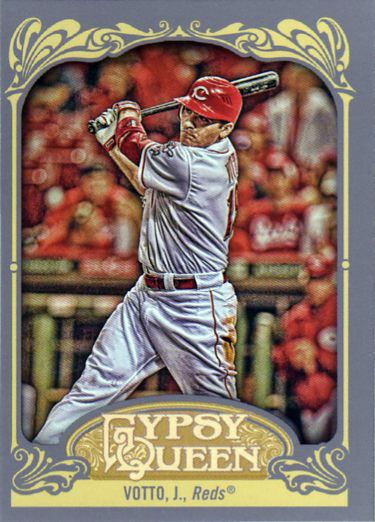
2012 Topps Gypsy Queen #220 Joey Votto


Comments on the card/player: The second year for Gypsy Queen which I liked quite a lot in 2011. I didn't like this as much and I like it less and less each year.
How/When acquired: I paid $0.43/card for a hobby box of Gypsy Queen in April 2012.

Card #54371
2015 Topps Update #189 Adam Warren


Comments on the card/player: I remember everyone, including me, being pretty excited about the 2015 Topps design early in the year. But I was getting burnt out on the design by about half-way through this enormous 400-card update set.
How/When acquired: I aid $0.12/card for a hand-collated set of Topps Update plus inserts from eBay in October 2015.

Card #38735
1988 Donruss #480 John Morris


Comments on the card/player: Hey, another in the string of weird Donruss designs. I have more than half of this 660 card set despite never buying a single pack of it.
How/When acquired: Paid $0.04/card for 100-card Fairfield Repack in arch 2013. Repack fodder, that's why I have so much of this.

Card #32440
2012 Topps Gypsy Queen Future Stars #FS-EH Eric Hosmer


Comments on the card/player: Hosmer was 3rd in the ROY voting in 2011 and he's had a pretty good career since, gathering 3 Gold Gloves and a World Series ring along the way.
How/When acquired: In addition to buying a hobby box of this product as mentioned above, I also bought a rack pack and a blaster box for $0.46/card, which is where I pulled this card.

Monday, January 11, 2016

Repack Madness 2015 - Part 1

I bought a few repacks this year but didn't get too many of them open until the end of the year. So late November into December was a time of opening repacks. I'm pretty happy if I need 50% of the cards I get in a repack. I figure that the per card price is low and the cards I don't want can be trade bait for later. And by card I need, I pretty much mean any card I don't already have.

I bought 2 repacks on 3/22/15. This first one, from Fairmount, had some packs and some loose cards amounting to 89 cards. I needed 46 of them for a 51.6% keep rate. Above target!  Now were any of these cards any good?

1987 Hygrade All-Time Greats Grover Alexander


I had 2 cards from this 100-card set. I had a heck of a time trying to figure out what these were when I got the first one. The cards are not numbered and do not have a manufacturer's name. They were made by Hygrade Food Products is located in Detroit and got their start by supplying hot dogs to the Tigers. I remember Hygrade Franks as a kid. Today they are known for Ball Park Franks. I imagine this set came in packs of hot dogs or were available through mail order. tradingcardsdb.com has a full checklist. As a bonus (for me) Alexander was a Phillie from 1911 to 1917.

1987 Hygrade All-Time Johnny Bench


Now I have four.

Update: So much for the hot dog theory. Hygrade was a company that sold baseball card price guides in the late 1980s. See this post http://wrigleywax.blogspot.com/2010/07/more-from-hygrade.html. And thanks to blogger Laurens.

1990 Topps Hills Hit Men #32 Cal Ripken, Jr.


Another food-related product I don't know too much about. I believe this glossy 33-card set was issued by Topps for Hills Brother's Coffee. 33 cards is the general size of a set that came packaged like playing cards. By coincidence, both Hygrade and Hills Bros are owned by Sara Lee these days.

1991 Upper Deck #91 Tom Pagnozzi

Pretty good bunt photo. Someday I will own 1990, 1991 and 1992 (and maybe 1989) Upper Deck sets, acquired mostly from repacks. I pulled 2 other '91s plus a checklist from 1990 UD.

1991 Bowman #410 "Shot Heard Round The World"

1991 Bowman was an early example of a set to employ gold stamping, although they only used it on certain cards, like for MVPs and Rookies. It was also unusual to put gold stamping on a non-glossy card. It still is unusual today.

1992 Megacards Ruth #38 Babe Ruth


These were issued from 1992 through 1995, I don't have enough of them to tell, but I imagine they cover Ruth's career from the early years to the end. The card is glossy and printed a nice sturdy white card stock.

A large portion of the cards were recent packs.

2013 Topps Archives 1983 All-Stars Cal Ripken, Jr.


2 Ripken cards in the package. Not too bad.

2014 Topps Allen & Ginter Mini Gold #97 Sparky Anderson


I really like to get cards for my Reference Albums. I didn't even know these existed. Neither Beckett.com nor baseballcardpedia.com mention them. I finally found them in tradingcarddb.com. They have the checklist but images for only 4 cards from the 350-card set (now including this Anderson card). Does that mean they are rare?


Tuesday, April 7, 2015

Baseball Card Evolution through the 1990s - Bowman

I started collecting cards in 1985. From that vantage point it seemed that baseball cards had been pretty static for years. Sure, Donruss and Fleer came on the scene in 1981, but by 1985, they were pretty set in their ways. By 1990, we had three more major card brands, Bowman, Score and Upper Deck. The stage was set for some changes. In this series I'm going to focus on the brands that were available in 1990: Bowman, Donruss, Fleer, Score, Topps and Upper Deck. Most of these brands lasted the whole decade. Lots of other brands came (and some went) but these other brands were a reaction to the increased competition that was driving innovative design changes so they don't add anything to the story I'm trying to tell.

I'm going to do these in alphabetical order, so Bowman is first.

1990 Bowman #486 Nolan Ryan
Topps resurrected the Bowman brand in 1989 and it almost died in the crib. The cards were taller than 'normal' cards and weren't liked. In 90, Topps shrunk them to normal size. The first three years didn't have much to differentiate them from each other or from regular Topps cards. They tried some innovative stats on the back but nobody liked that either although they did it for most of the decade. Most of the cards featured a static photo of the players.

1991 Bowman #569 Chipper Jones

Although Bowman had yet to establish itself as the "Home of the rookie card", they did include an early Chipper Jones card. But there's not much seriously different about this design compared to 1990. They even have the same stats on the back. They did, however, start to mix some action shots into the selection of photos.

1992 Bowman #127 Carlos Delgado
In 1992, Bowman really upped it's game. Gone was the gray non-glossy cardboard. They went with a nice white card stock and a medium glossy finish on the front, and a color photo on the back. Another innovation was in the use of foil, with some rookie cards having foil borders. Still the same goofy stats however. I remember being in a card store in 1992 looking for Bowman and not finding any. A couple of guys commented "Why would anyone be interested in Bowman"? This Delgado card I got for free in another shop when the owner gave me a free pack for being a good customer.

1993 Bowman #511 Derek Jeter
A nice clean card front and thinner borders make this a nice design. The back features a larger photo. In those days, Bowman didn't get released until about mid-August which gave them a chance to include any rookie players who made a splash earlier in the year. Of course Jeter won't make his debut until 1995 but by 1993 everyone knew who he was and he was featured in most sets that year. Most of the cards in this set feature on-field action shots and the foil-lined cards were again featured for some hot players.

1994 Bowman #75 Cal Ripken
 Two major design changes for Bowman in 1994. Full bleeding printing and gold foil are old school today but it was cutting edge in 1994.

1995 Bowman #293 Roger Clemens
Bowman pulled back from the full bleed edge in 1995 and never went back there. But there are a number of changes here. The use of red foil for the logo will be a feature for several years. Silver foil is used for the player name. To me, this card front is too complicated. The elongated photo along the left edge is similar to what Upper Deck did in 1994 (I didn't like that much either).  Another first for Bowman this year is the use of team logos in the front, which will be a feature right up to the present. Bowman will feature another innovation, holographic foil on some cards.

1995 Bowman #246 Aaron Boone
1996 Bowman #35 Mark Grace
The red foil logo and the silver foil player name are back but the card borders are nicer than 1995. I like the effect of the player extending into the border area. The card backs are brighter as well.  The big change this year is more in focus. By now, Bowman had established itself as the home of the rookie card and a large part of the set was devoted to rookies and prospects.

1996 Bowman #346 Matt Beech
It's also the first year they used the "1st Bowman Card" logo.

1997 Bowman #232 Curt Schilling
This is the first year that Bowman used the black and red motif for veteran players and black and blue for rookies and prospects. This will be the guiding design factor in Bowman cards for the next 14 years.

1997 Bowman #411 Miguel Tejada

1998 Bowman #1 Nomar Garciaparra
Bowman used gold foil on the card fronts this year. They will switch randomly among  gold, silver, and red right up to the present. The next step in Bowman evolution is the addition of a facsimile signature. This will be a Bowman feature until 2009.

1999 Bowman #262 Dante Bichette
This year Bowman added a semitransparent signature block on the card. Most sets will have this up to 2009, except it will be at the bottom of the card. Some years it will be very obtrusive. They also dropped the performance against teams stats and opted for just showing the player's previous year and career total stats.

That's it for 1990s Bowman. Quite a lot of changes throughout the 1990s but by the end of the decade, the Bowman design will be pretty much set, with the exception of green and black cards for prospects in a few years, through 2011.